2026-10 - W4
The State of Context Engineering
Colorfigures skill · April Zhu
Cool animations.
This is not sustainable
Oof.
An update from Amazon engineering leadership on the role of the developer in the age of AI
Why are good developers so wary of agentic development?
Good developers’ caution about agentic development comes from knowing that built isn’t the same as working in production.
Java’s new AOT cache feature is in a rough state
Mmh, AOT not ready yet…
Were All Those Years of Coding Wasted? - by Adam Tornhill
There are two takeaways:
- As experienced coders, we spotted the pattern quickly. Just like a speed reader consumes text in patterns rather than word by word, a strong manual coding background has trained us to spot algorithmic weaknesses and flaws. Those skills are clear advantages when skimming over chunks of generated code.
- The less we control the implementation, the more important it is to control the characteristics we depend upon. Perhaps we need to include automated performance checks for all code, not just the ones we’d normally consider the hot path. It sounds expensive, but the alternative might be worse.
AI Promised Less Work. I Have Never Worked More. - Orestis Ioannou
Work load comparison when the author was an Full Stack Engineer, Principal Engineer and VP of Technology. There are more burst than before, hence more easy to burn out.
At the end of a burst, I feel tired of AI. I do not want to start another agent or think of more ideas. I do my normal work, but I stop chasing the extra projects and possibilities because I do not have the mental bandwidth for them.
Two years later, I know what I got wrong about typed domain errors and what I’d keep - ShiftMag
Interesting take.
AI Isn’t Replacing SREs. It’s Deskilling Them.
Basically, I’m drawing a parallel between the AI revolution and industrial automation. Industrial automation reshaped blue-collar work by taking over routine physical tasks, and the workers who remained had to handle exceptions they’d lost the muscle memory for. AI is doing the same thing to knowledge workers by taking over the routine cognitive tasks, the pattern matching, the triage, the known-issue resolution and leaving humans with the rare, complex, ambiguous problems.
The exact problems that require deep expertise, the exact expertise that atrophies when you stop practising.
Now we’re replaying this pattern with AI agents, and the stakes in software systems are only growing. … We are definitely not rejecting AI tooling; we are adopting it and integrating it stronger than ever before, because that’s the only way forward.
A few approaches worth considering:
Deliberate inefficiency. Just as the FAA mandates manual flying time even when the autopilot is perfectly capable, SRE teams can designate certain incidents, even the ones the AI could handle, as human-practice opportunities. This can be considered as a long-term investment to keep skills fresh, although it might come at the cost of a super-fast solution
Build for human-in-the-loop, not human-on-the-side. There’s a meaningful difference between a system where a human approves an AI’s recommendation and one where a human actively engages with the problem alongside AI. The former keeps humans in a supervisory role that Bainbridge (the lady who wrote that research paper about 40 years ago) showed leads to vigilance decay, and the latter keeps them cognitively engaged.
Design as a garden - Justin Jay Wang
- Cultivate the right conditions. You can’t force a plant to grow at 2pm. But you can tend the soil to give something good the best chance to take root.
- Let different things cross-pollinate. Interesting work comes from unexpected combinations. Go watch a movie. Read a book outside your field. Talk with someone who sees the world differently.
- Protect what’s fragile. A young but promising idea can easily be killed before it’s had a chance to develop. Shelter it from premature judgment.
- Come back tomorrow. Persistence isn’t doing the same thing over and over. Stay with something long enough and you may find another way in.
- Prune what’s not essential. Space, attention, and resources are limited. Sometimes you have to cut something good to let what is most vital flourish.
- Not every plant needs to bear fruit. Some plants are worth growing just because you like having them in the garden. Not everything needs a clear payoff.
- Plan for unplanned space. Don’t fill every inch. Build in room for play, improvisation, and plants you never meant to grow.
- Avoid harvesting too early. Let an idea fully mature before you ask it to perform. Don’t hurry to pick a direction. Stay open to where else the idea may lead.
- Leave some ground fallow. Don’t always demand visible results. Step away from time to time. Notice. Absorb. Form new connections. Live a little. It may be quiet on the surface. But below, the soil is renewing itself.
- Match effort to the season. Ask yourself: does this need more effort — or simply more time? Practice patience. And when the time is ripe, work intensely.
Amazon sends chills through its workforce with mixed message memo about AI use - Corey Quinn
The memo says tokenmaxxing is at odds with frugality, and for Amazon’s internal cost line, it is. Meanwhile AWS bills Bedrock and Kiro customers by the token. Inside the building, tokenmaxxing is a problem to be stamped out. Outside it, it’s the revenue plan.
What Do You Still Need to Know When Agents Do the Work?
Some good advice in this AI era where learning expertise is still in the unknowns.
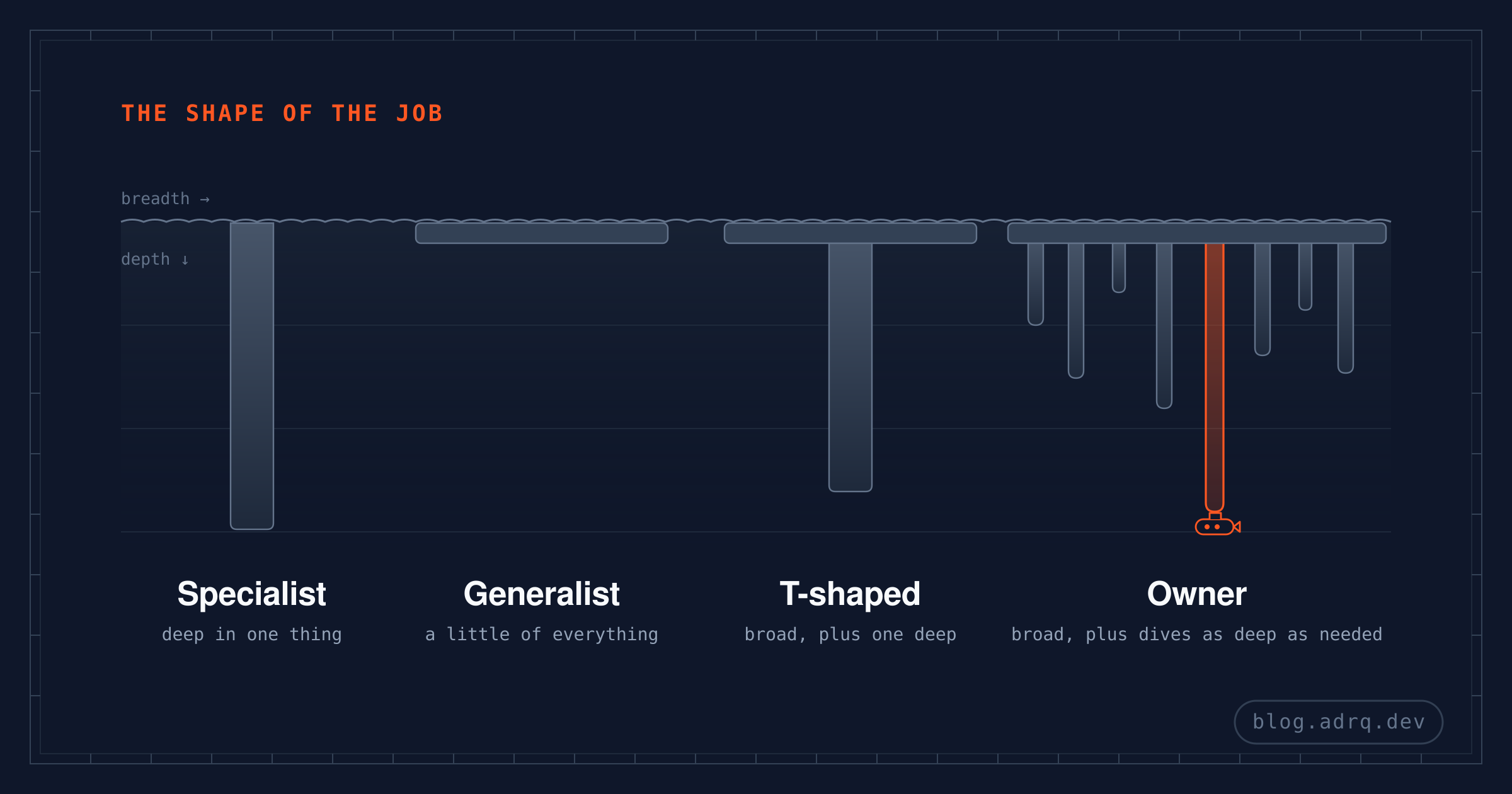
The traditional wisdom is that in order to develop and maintain a non-trivial system you need to have a proper working model of it. I think few people would argue with that. And in software engineering you would acquire that working model by working directly with the code. Years and decades of practice writing and reading code give you the knowledge and tools needed to understand the systems you’re responsible for. Every production incident, every late-night debugging session, every successful release. All of these experiences give you the perspective needed to have ownership of a system. In the context of this post, ownership means you’re the one who gets called when something breaks. … The fact is that the way that today’s senior engineers learned, ie. through coding by hand, endless hours debugging, production incidents, etc. is not a path that is viable for juniors today. To be clear, it is not economically viable, meaning that it is highly unlikely that companies will be willing to sponsor juniors for years while they “learn to do it by hand”. That’s wishful thinking. An alternative that is often presented is the “make sure you understand every line your agent wrote” advice, or “pair with a senior”, or “perform careful code reviews”. Again, wishful thinking at all but perhaps a few shops. … As an owner of a system you need to understand the failure modes of the system. As an industry we have the tools to teach folks how to detect and reason about these failures: fundamentals. And the good news is that we’ve been teaching them to unwitting CS majors for decades. I’m talking about data structures & algorithms, networking, concurrency, distributed systems, etc. It doesn’t have to come from a formal education either, these are topics you can read about and learn on your own. Which brings me to the next pillar of ownership: breadth. Most of the successful engineers and engineering leaders I have had the pleasure of working with were able to hold a discussion on almost any topic, whether technical or not. They may have been specialists in certain things, but what was most impressive was their ability to draw upon and weave together seemingly disparate concepts from different disciplines and use that knowledge to solve problems. This is the high-level map of the waters. This is what tells you certain seas are more dangerous than others. The breadth of knowledge is what enables you to say “let’s dive here”. Someone asked me “how do we teach breadth? a survey class on everything?“… The most we can do is encourage folks to read/explore/be curious. Absorb as much information as you can. Remember the weird incidents, the “oh crap” moments, think about how they connect to your work. And as you gain more experience, make a conscious effort to connect your everyday experiences with your work. The final pillar of ownership is what I call just-in-time depth. This is the ability and willingness to dive into any problem and figure it out. Even if you’re in uncharted waters. … The new way of building things requires a generalist who can dive deep into the unknown, a “quick learner under pressure” and not in the resume-padded way. You will actually need to be able to learn quickly while fighting with sea monsters.
HackerTube – karpathy
Interesting way to easily create a Youtube clone with its own recommendation based on Hackernews, all that in a couple of hours.